

Why Real Estate Analysis Matters | ACI
A disciplined framework for understanding property value, evaluating investment risk, and comparing commercial real estate opportunities.
By Billy Joseph | February 7, 2025 | 10 min read
In real estate investing, success hinges on more than just intuition or market
trends. Thorough, efficient and focused analysis is essential to making informed decisions and mitigating risks. Whether you’re purchasing a single- family rental property, a self-storage facility or a multifamily property, understanding the financial and market dynamics can mean the difference
between success and failure.
In this post, we'll cover the various asset classes available to investors and the primary property types within the real estate asset class. Next, we’ll cover the
purpose of real estate analysis, what questions it should successfully answer, what is involved and the key benefits. Finally, we'll discuss some of the major components of real estate analysis.
This post covers:
Real Estate Asset Class
Real estate analysis involves evaluating the potential performance and risks associated with a property.
Before we go any further in our discussion of real estate analysis let’s first look at the big picture. Investment opportunities are organized into groups of financial instruments that have comparable characteristics and exhibit like behaviors in the market (Yieldstreet). Some examples include stock, bonds,
and a large group called alternatives. Within the alternative asst class you will find real estate along with private equity, and crypto.
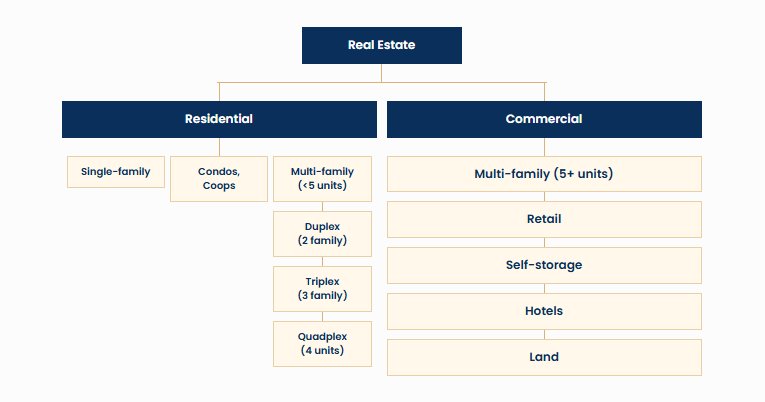
Further still within the real estate asset class you will find two broad property
types: commercial and residential. Commercial Real Estate (“CRE”) includes any property that generates income such as hotels, retail, self-storage and even land. On the other hand, residential property is simply real estate for living and it includes single-family homes, condos, and multi-family properties.
However, if the multi-family property holds more than four units, it is classified as CRE. This key distinction plays a big part in how we value and analyze real estate investments.
The value of residential real estate is determined by the comparable sales approach which assigns a market value to a property based on the recent
sales of similar properties within close proximity to the subject property. In contrast, the value of CRE is determined by the income capitalization approach which assigns a market value to the property based on the property’s Net Operating Income (“NOI”) relative to the overall rate of return on capital required by investors of similar investment properties (Eldred). This
required return is known as the Capitalization Rate (“Cap rate”) and is an often used but misunderstood concept.
To illustrate how these two approaches yield very different results let’s
consider a scenario with two properties: Property A and B which are in the
same neighborhood just a few feet apart. Property A, a fourplex built in 2010, is 4,000 square feet, features luxury amenities and generates an annual NOI of $144,000. Property B, a five-unit apartment built in 2000, is 4,000 square feet, features only the bare necessities and generates an annual NOI of $100,000. In
the last 6 months, there were three sales transactions of similar fourplex properties with an average sales price of $250 per square foot. Currently, the prevailing Cap rate in this neighborhood is 8%. Below illustrates the resulting indicated sales price of each property:
As you can see, Property B, which has a lower NOI, fewer amenities and is an older property is 25% more than Property A. It is these favorable economics that make investing in commercial multi-family properties so attractive, and this asset group is the focus of many CRE investors.
What we have just described are two very simple valuation techniques. An investor needs to have a good understanding of the value of a property but that alone isn’t enough. They need to be able to answer a few important
questions all based on the quality of an investment before making an informed decision.
Real Estate Valuation vs Analysis
In the preceding example we discussed valuation but that alone is not
enough. An investor shouldn’t decide based on a valuation alone. Analysis is the next step. Real estate analysis involves evaluating the potential performance and risks associated with a property. This process examines critical factors like market trends, property condition, financial performance,
and the identification and mitigation of risks. A thorough analysis should
address the following:
Using a series of objective metrics, you can compare multiple investment opportunities against each other. The ultimate goal is to determine whether
an investment aligns with your financial objectives and risk tolerance. Some of the more common investment goals we've come across are
Having a good working knowledge of real estate analysis will help you reach your overall goals faster.
Key Benefits of Real Estate Analysis
Market understanding
Market analysis provides insights into supply and demand dynamics, demographic trends, and economic drivers. This involves researching local
employment and population growth trends, and comparable property performance. This knowledge allows investors to target high-growth markets or avoid over-saturated ones.
Risk mitigation
Real estate investments come with inherent risks, including market volatility, unexpected expenses, and tenant turnover. A comprehensive analysis helps identify potential red flags, such as declining market demand or insufficient rental income.
Maximizing returns
Through proper analysis, investors can uncover opportunities to improve a property’s performance, such as value-add strategies, optimizing rental rates,
or reducing operational costs. This ensures that investments achieve their maximum potential.
Informed decision making
By analyzing a property’s financial metrics investors gain a clearer understanding of the quality of the investment. This data-driven approach minimizes reliance on speculation and focusses the investor on objective and trusted data.
The Six Most Important Metrics in CRE